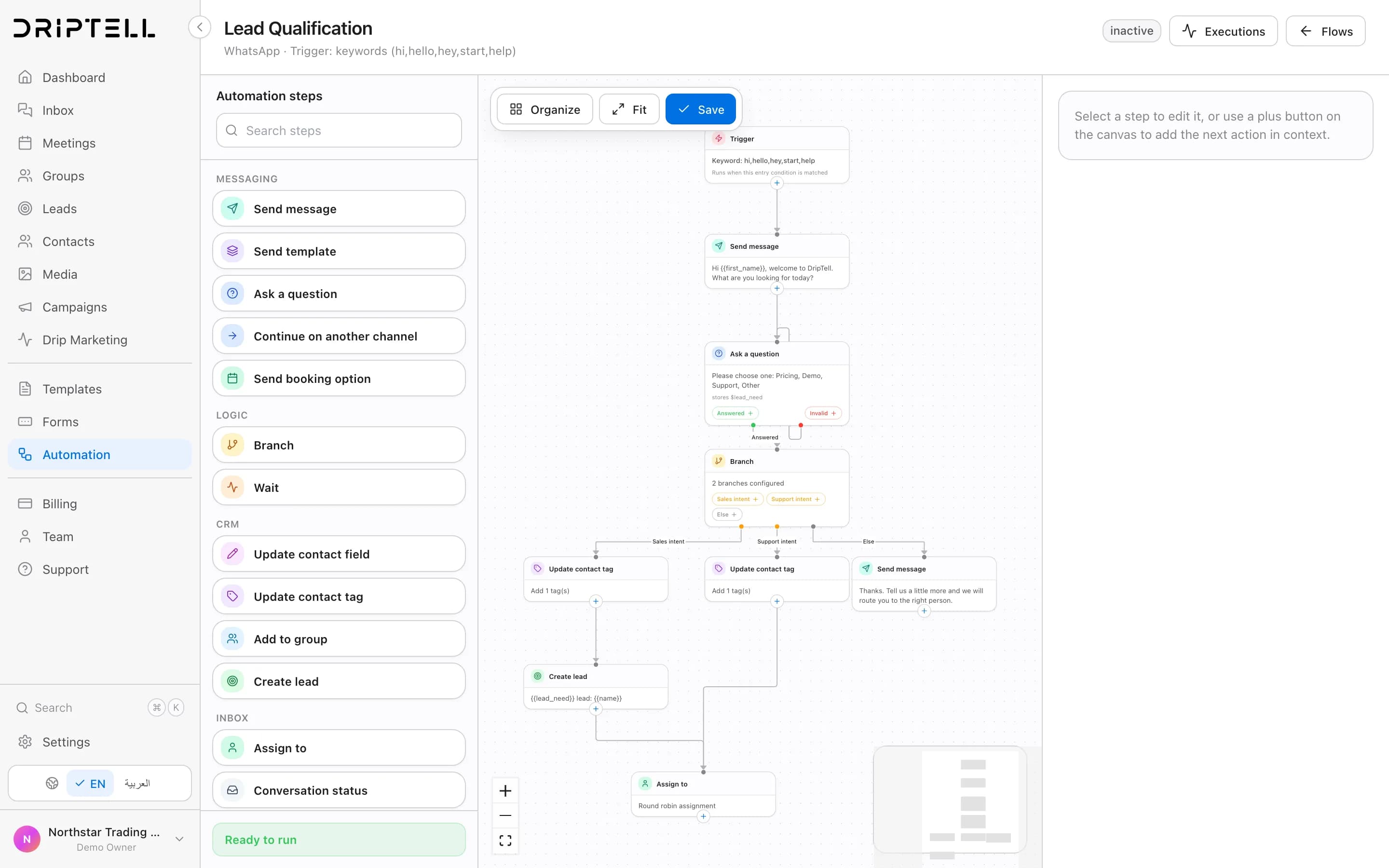
Build the exact customer journey your team is already trying to run.

Messages, decisions, assignment and external systems share one visual canvas, with every handoff visible to the operator.

app.driptell.com
Build the exact customer journey your team is already trying to run.
Real DripTell product view

Start from a real customer signal.

Trigger a journey from an incoming message, keyword, form, campaign response, lead change, group event or external webhook.

Channel and CRM triggers

Intent, field and audience conditions

Reusable journey patterns

1UnderstandWorkflow
2DecideWorkflow
3ActWorkflow
4Hand overPerson

Make routing and judgment explicit.

Detect intent, score the lead, update a field, switch channel, wait, call another system or assign the conversation. Operators can see what happened and why.

Conditions and branching stay readable

Round-robin or rule-based ownership

Outbound webhooks connect wider operations

Build the exact customer journey your team is already trying to run.

Hand over without losing the thread.

A person receives the conversation, the extracted context and the next action. Automation can pause, end or continue from a deliberate state.

DT

One customer record

Context ready for the next action

The customer need, previous conversation and next action stay attached.
The right owner can continue from here.
Next actionAssigned and ready

Questions teams ask before they connect the workflow.

What can customer service automation handle?

It can collect routine details, identify intent, update the customer record, route the conversation and provide approved information before a person takes over.

Does automation stop when a person replies?

Workflows can be designed to pause, end or change state when the customer or a teammate replies, preventing automated messages from talking over a live conversation.

See it working with your own customer journey.

Bring the messages, rules and follow-up your team already uses. We will map the flow inside DripTell.