





Want help applying this guide?Ask the DripTell team
At 9:10 a refund request arrives with three attachments and a long history. Two password reset questions arrive behind it. An agent opens the shared queue, takes the quick resets and leaves the refund for someone else. Nobody has broken a rule. The customer with the harder problem simply waits.
Support agents should not choose all their own work from a shared queue. Automatic assignment is the safer default for routine, live and time-sensitive work. Controlled picking can help with specialist cases when the right expertise is hard to classify in advance, but only if one person owns the queue, every case has a pickup limit and unclaimed work moves to a defined recovery path.
Make automatic assignment the ordinary path
A queue is not ownership. It is only a place where work waits. If everyone can see a case but nobody is accountable for taking it, the customer has no real owner.
- Define the boundaryName the exact request types that agents may pick and keep routine live work outside it.
- Choose the defaultUse automatic assignment unless specialist context cannot be classified reliably.
- Name the queue ownerGive one person responsibility for aging, difficult and unclaimed work.
- Time the pickupSet a short visible limit before an unclaimed case moves to recovery.
- Review outcomesCompare response, transfers, resolution and case difficulty by assignment path.
Automatic assignment removes a choice at the moment when speed matters. It can distribute eligible work by availability, load or a stable sequence. This is especially useful for chat, high-volume messaging, simple service requests and any promise measured in minutes. The broader support operating model should say what counts as eligible, when ownership begins and what happens when an offer is not accepted.
Microsoft describes automatic assignment through rules and a default first-in-first-out approach. Its assignment method documentation also distinguishes pick-based queues where work remains unassigned until an agent or supervisor chooses it. That distinction matters because a visible queue can look healthy while its oldest difficult case has no owner.
In a shared inbox, show both the common queue and the named current owner. The handoff from waiting to owned should be an event, not a guess inferred from who last opened the conversation.
Keep manual picking narrow and intentional
Picking is useful when human recognition is better than the available classification. A technician may recognize an unusual device fault from a photo. A relationship manager may know the history behind a delicate account. A multilingual specialist may spot nuance that a form did not capture.
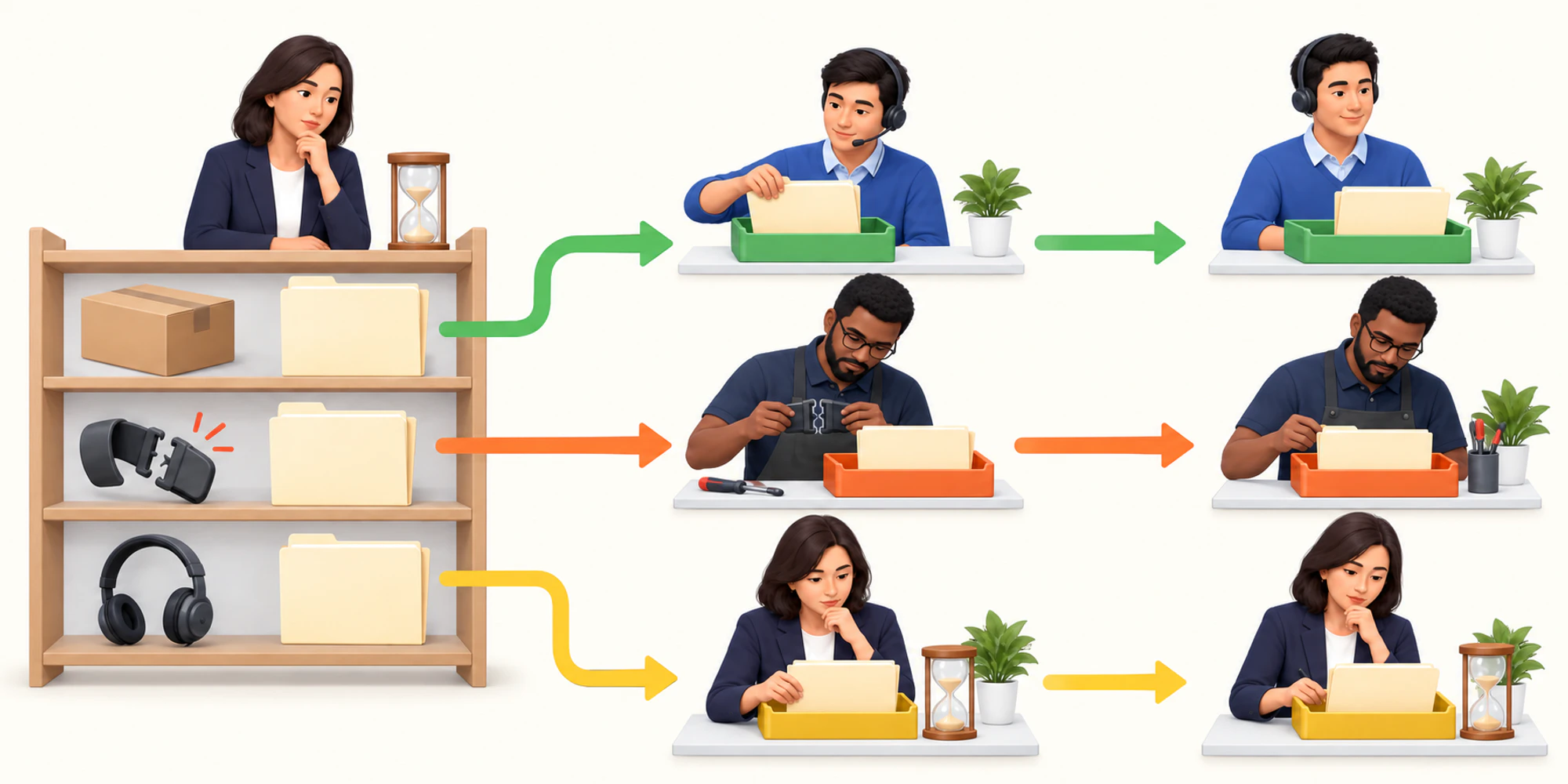
Those are reasons to create a controlled specialist pool. They are not reasons to let every agent browse all work. Define the exact request class, the people allowed to pick it and the evidence they need before claiming it. Use access controls so browsing a queue does not expose unrelated customer history.
Microsoft also documents the direct act of taking an item from a queue. Its queue work guidance says a manual pick records the representative as working the item, but does not evaluate schedule, assignment rules, skills, presence or capacity constraints. That makes the operating boundary important: a person may be allowed to see and claim an item even when an automatic rule would not have selected them.
Give every queue a clock and an owner
A controlled pick queue still needs one accountable supervisor or rotating queue owner. That person watches age, difficulty and the gaps nobody volunteers to take. Set a short pickup time for each service class. When the limit passes, assign the case automatically, escalate it to a qualified lead or pause new picking until the backlog is safe.
The recovery rule should preserve original arrival time, priority, context and promised next action. Automation can move the work, but the policy must state why the move happens and who becomes responsible. Never reset the clock when a case changes path.
| Assignment model | Works when | What must be visible | Failure to watch |
|---|---|---|---|
| Automatic assignment | Work is routine, live or time sensitive | Eligibility, capacity, offer and acceptance | Bad classification sends work to the wrong person |
| Controlled pick | Specialist context is hard to classify reliably | Allowed pool, case age and named queue owner | Easy work is selected first |
| Supervisor assignment | Risk or authority needs human judgment | Decision reason and final owner | The supervisor becomes a bottleneck |
| Hybrid recovery | Picking helps but delay cannot be tolerated | Pickup limit and automatic fallback | The fallback hides repeated avoidance |
The table is a decision matrix. The visual checklist beside this article is the operating sequence. Use both. One chooses the model; the other makes it accountable.
Test whether choice changes behavior
Do not evaluate a pick policy only by average response time. Compare picked and automatically assigned work by request type, age and difficulty. Look for a rising gap between easy and complex cases. Review transfers, meaningful response time, full resolution time, reopen rate and the number of cases rescued by a supervisor.
Sample the queue at ordinary moments, not only during a review. Ask which case is oldest, which has been viewed but not claimed and which person can complete it. AI assistance may help summarize or classify a case, but it should not conceal the selection event or invent an owner.
Listen to agents as well. Repeated avoidance can reveal missing authority, unsafe access, poor training or an unrealistic service promise. The answer may be better tools or a narrower role, not tighter surveillance.
Write the policy before changing the tool
State the default in one sentence. For example, routine inbound work is assigned automatically; named specialists may pick defined exception work for ten minutes; the queue owner assigns anything left after that limit.
Then test routine work, a difficult case, an absent specialist, full capacity and a returning customer with history. Confirm that the original timestamp survives and that only qualified people can open the work. Record the effective date, owner and rollback point. A small reversible pilot is better than a broad setting change.
DripTell can keep assignment, history and automation events with the conversation, but the choice still belongs to the service leader. If you want to map the policy to your current workflow, talk with the team.
Frequently Asked Questions
Should support agents choose their own tickets
Not as the default. Automatic assignment is usually safer for routine, live and time-sensitive work. Allow picking only for a defined specialist pool with an owner and recovery rule.
When is manual picking useful
It helps when a qualified person can recognize specialist context that forms and rules cannot classify reliably. Keep the permission narrow and review the resulting customer outcomes.
How do you prevent agents from choosing only easy work
Make case age and difficulty visible, name a queue owner, time the pickup window and automatically recover unclaimed work. Review selection patterns by request type and person.
What should a queue owner monitor
Watch the oldest unowned case, viewed but unclaimed work, pickup time, transfers, supervisor rescues and whether complex cases receive slower service than routine ones.
DripTell Editorial
Practical guidance reviewed by the DripTell product and customer workflow team.
See how DripTell checks product claims, uses primary sources and handles corrections.
Editorial and source policy