




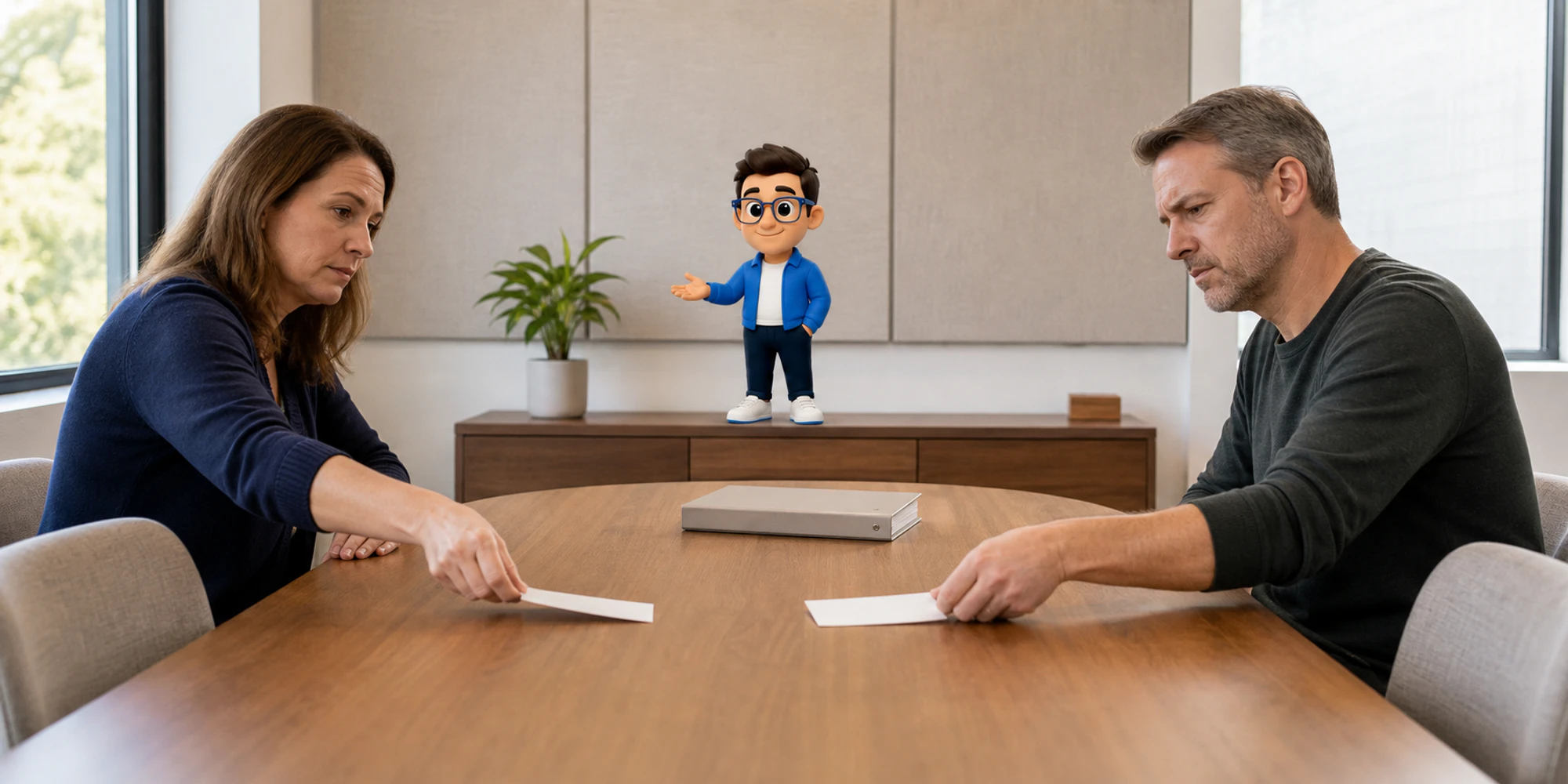
Two reviewers listen to the same customer conversation. One marks it as acceptable. The other sees a serious failure. If the team averages the scores and moves on, the calibration meeting has hidden the most useful evidence it produced.
Customer service QA calibration should make scoring reproducible. Give reviewers the same interaction, evidence, rubric version, and policy context. Let them score independently. Then compare each criterion, classify why they disagreed, assign the right owner, and test the clarification on untouched work. The goal is not agreement in the room. It is a standard that different reviewers can apply later without being coached toward the answer.
Calibration protects the measurement
A customer service QA scorecard can be well designed and still produce unreliable results. A phrase such as “showed empathy” may mean an apology to one reviewer and recognition of the customer’s specific loss to another. A critical privacy failure may be obvious in a call recording but invisible in a shortened transcript.
- 1Freeze the evidenceGive every reviewer the same interaction, policy, and rubric version.
- 2Score independentlyCapture criterion decisions before anyone sees another score.
- 3Compare criteriaKeep critical errors separate from style preferences and totals.
- 4Assign the causeRoute evidence, rubric, policy, or reviewer issues to the right owner.
- 5Retest the ruleUse a fresh holdout interaction to check reproducibility.
Microsoft’s current evaluation criteria documentation treats questions, answer choices, scoring instructions, critical items, versions, and a simulation as explicit parts of a quality framework. That supports a useful discipline: the meaning of a score must be written and versioned, not left in the room. The practical test is whether a reviewer who missed the meeting can apply the same rule from the standard and available evidence.
Do not use calibration to repair a biased sample. Decide which conversations enter QA through a separate sampling plan. Calibration tests how the sample is judged, not whether it represents the work.
Freeze the evidence before anyone scores
Every reviewer needs the same evidence package. For a voice contact, that might include the full recording, timestamps, transfer history, the policy effective on that date, and the customer outcome. For messaging, preserve the full thread rather than a selected screenshot. Limit access through a clear conversation access model, because calibration does not justify opening unrelated customer data.

Record the rubric version and policy date. If one reviewer uses today’s refund rule on a conversation from last month, the difference is not reviewer drift. It is a version-control failure.
Score independently before discussion. No reviewer should see another score, explanation, or manager preference first. Microsoft’s evaluation results documentation also exposes the evaluation criteria and can show the version attached to a result. That makes the score traceable to a defined instrument. Independent scoring adds the missing human control by preserving what each reviewer decided before discussion could anchor them.
Compare criteria before totals
A total score can conceal the decision that matters. Two reviewers may both award 82 percent while disagreeing completely about privacy, accuracy, and next-step ownership. Compare criterion by criterion and keep critical failures separate from style preferences.
Ask each reviewer to cite the observed moment, the rule applied, and the evidence that was available. “It felt dismissive” is not enough. “The agent promised a refund before checking eligibility” gives the team something testable.
The useful unit is the disagreement, not the reviewer. Capture it before the group talks. Consensus reached after a senior person speaks cannot be used as proof that the original instrument was clear.
Classify the disagreement
Not every difference needs more reviewer training. Some expose missing evidence, vague scorecard language, conflicting policies, or a decision that only a policy owner can make.
| Disagreement source | What to check | Right owner | Practical action |
|---|---|---|---|
| Observable fact | Whether both reviewers saw the full interaction | QA lead | Restore the source record and rescore |
| Missing context | Whether order, identity, or transfer evidence was available | System owner | Repair evidence capture or access |
| Ambiguous criterion | Whether reasonable readers can apply the wording differently | Scorecard owner | Rewrite the criterion and add examples |
| Policy conflict | Whether current instructions disagree or lack authority | Policy owner | Decide the rule and effective date |
| Reviewer drift | Whether the written rule is clear but applied inconsistently | QA coach | Practice with new examples and recheck |
Repeated ambiguity may point to a deeper process problem. Feed it into root cause analysis rather than rewriting one score after another. If reviewers repeatedly lack a current answer, connect the finding to the knowledge base gap process.
Write the decision and test it again
The calibration record should preserve the interaction ID, rubric version, original criterion scores, cited evidence, disagreement class, final decision, owner, and effective date. Keep the original scores. Overwriting them makes later improvement impossible to measure.
When the rubric changes, start a new comparison period. Do not mix scores from old and new definitions as if they are one trend. Give reviewers a fresh holdout interaction that was not discussed in the meeting. If they now apply the clarified rule consistently, the change probably helped. If they still disagree, reopen the criterion or evidence package.
Measure agreement by criterion and contact type, not only as one overall percentage. A high overall figure can hide unstable privacy, payment, safety, or unsupported-promise decisions.
Use a cadence that follows change
Run calibration when a scorecard launches, a policy changes, a new reviewer joins, a channel is added, or disagreement rises. A steady monthly session may suit a stable operation. A changed refund policy may need a focused session this week. Cadence should follow risk and change, not a ritual calendar.
Keep calibration separate from individual discipline. First decide whether the rule, evidence, and reviewer application are reliable. Managers can then coach against an approved standard. Using an unresolved calibration dispute as a performance judgment destroys trust in the QA program.
For teams reviewing conversations across WhatsApp, Instagram, Messenger, and Telegram, a shared support workspace can help preserve assignment, notes, and conversation history. It does not make the scoring rule clear by itself. The calibration record still needs an owner and a tested standard.
Frequently Asked Questions
How many conversations should a calibration session use
Use enough interactions to expose important judgment calls without turning the session into routine production scoring. Include ordinary work and a few relevant edge cases. The right count depends on rubric complexity, channel mix, policy change, and reviewer experience. Do not present one small session as proof of whole-team reliability.
Should reviewers discuss the case before scoring
No. They should receive the same evidence and score independently first. Discussion is valuable after the original criterion-level differences have been captured. Otherwise anchoring and seniority can create artificial agreement.
What should happen when the policy is unclear
Pause that criterion as a performance judgment and send the question to the named policy owner. Record the decision and effective date, update the standard, then test the clarification on a fresh interaction. QA reviewers should not invent policy during the meeting.
Want help applying this guide?Ask the DripTell team
From reading to action
Want help applying this to your business?
Share your details. We will read the article you are on and start with a useful answer for your team.
DripTell Editorial
Practical guidance reviewed by the DripTell product and customer workflow team.
See how DripTell checks product claims, uses primary sources and handles corrections.
Editorial and source policy