A customer who buys your product in a supermarket and finds a problem will complain to the supermarket. A customer who bought it on your website will message you. That is the difference between B2C and D2C in two sentences, and it shapes your margin, your data and how much of your week goes on customer messages.
What D2C and B2C mean
B2C stands for business to consumer. It describes who you sell to: people rather than companies. It says nothing about how the product reaches them. A brand selling through supermarkets, department stores or marketplaces is a B2C business.
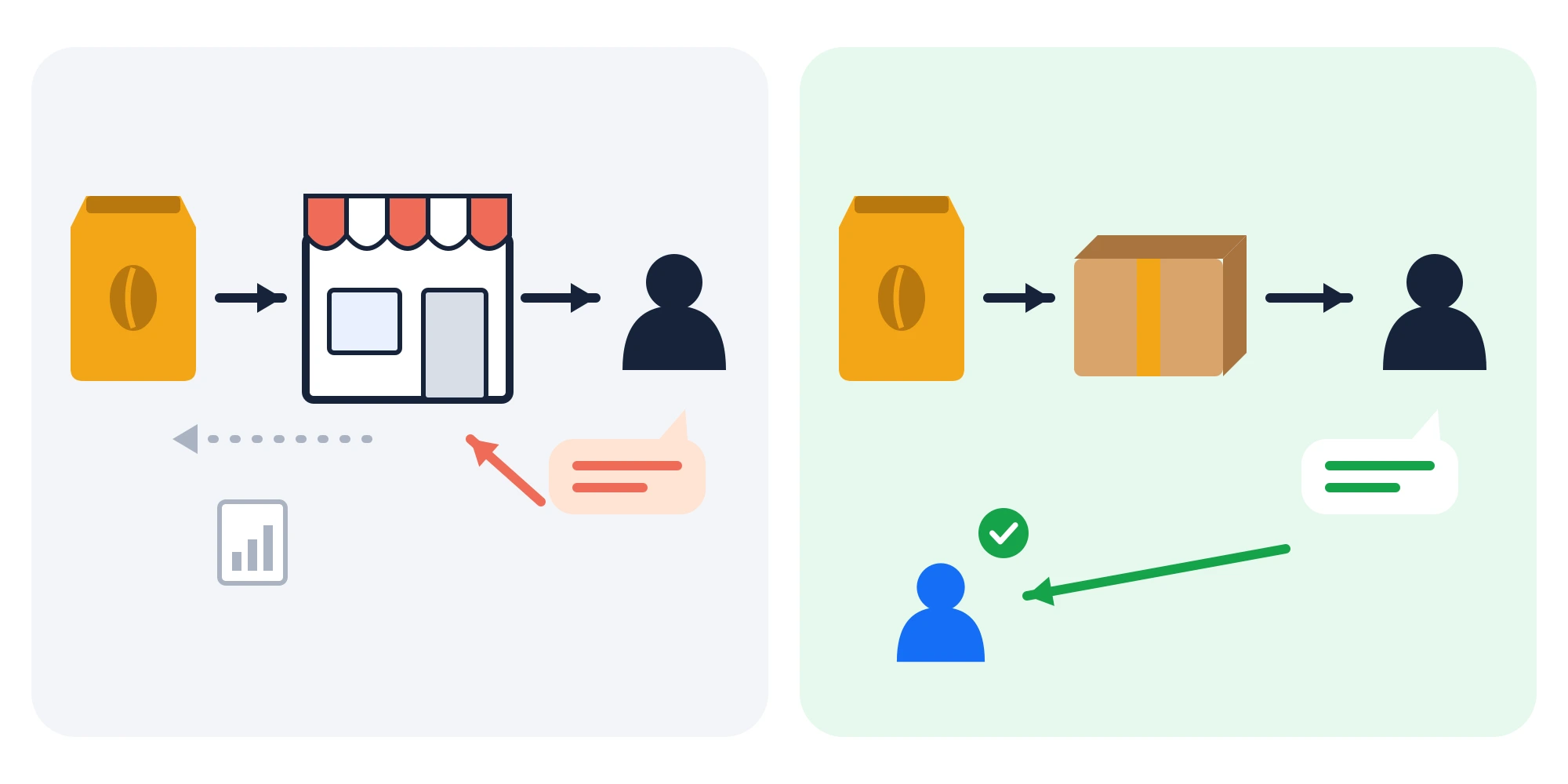
D2C stands for direct to consumer, sometimes shortened to DTC. It describes how you sell: from the brand straight to the buyer, through your own website, app, shop or chat, with no retailer in the middle.
So D2C is one way of doing B2C. Every D2C brand is a B2C business, but a brand that sells only through retailers is not D2C.
Where the two models really differ
Imagine a coffee roaster that sells bags in supermarkets and runs subscriptions on its own website. Same coffee, two very different jobs.
| Question | B2C through retailers | D2C |
|---|---|---|
| Who sets the shelf price | The retailer, adding its margin | You |
| Who knows the customer | The retailer | You, with consent |
| Who answers questions before purchase | Store staff or the marketplace | Your team |
| Who fixes delivery problems and returns | Mostly the retailer | Your team |
| Biggest cost you carry | Retailer margin and trade terms | Finding and serving customers |
| How you hear what went wrong | Sales reports, weeks later | The customer tells you |
The margin argument for D2C is real, because you keep the share a retailer would take. The table shows where that money goes instead: advertising, shipping, returns and the people who answer messages.
The support work most comparisons leave out
Most D2C vs B2C guides compare margins and marketing. The part that surprises brands is the inbox.
- Fast repliesSomeone answers messages within a few hours.
- Parcel ownerOne person is responsible for missing parcels.
- Consent recordedOpt-in is saved before marketing messages.
- Full costs countedShipping, returns and support are in the margin.
When a shopper finds a damaged bag bought at the supermarket, the supermarket deals with it. When a subscription bag is late, the customer writes to the roaster. They ask whether the beans suit a moka pot, whether they can skip a month and where the parcel is. Often those questions arrive by chat, on WhatsApp, Instagram or a website widget.
Those conversations are the real asset of selling direct. They show which products confuse people, which couriers fail and why customers cancel. They are also work, and some of it now has a price. On the WhatsApp Business Platform, a customer's message opens a 24 hour customer service window. Since 1 October 2026, Meta's pricing rules give each business phone number 1,000 free service messages a month and charge from the 1,001st.
What helps is unglamorous: one shared place for every chat channel, the order next to the conversation and a clear owner for each customer. We built the DripTell shared inbox for that, and the Shopify integration brings order details into the same view. Returns need their own process too, because a return request is not a refund.
Why most brands end up doing both
Selling only through your own website has a ceiling. In the second quarter of 2026, online sales were 17.1 percent of total US retail sales, according to the US Census Bureau. Most shopping still happens where a brand's own website cannot reach.
So the real question is which products and customers you serve directly. Common splits:
- Retail for discovery and volume, D2C for subscriptions and repeat buyers
- D2C for launches that need fast feedback, retail once proven
- D2C where people already buy through chat, retail elsewhere
If your customers already buy over chat, decide whether you need a WhatsApp catalogue, an online store or both before moving products away from retail.
Where to start
Check the service side before you change the sales side. If nobody can answer messages within a few hours, nobody owns a missing parcel, consent is not recorded before marketing messages or your margin ignores shipping, returns and support, start with one product or one market. See how retail and ecommerce teams handle that support across channels.
FAQ
What does D2C stand for
D2C means direct to consumer. A brand sells straight to buyers through its own website, app, shops or chat, with no retailer in between.
Is D2C the same as B2C
No. B2C describes the customer. D2C describes the route to that customer. All D2C is B2C, but B2C also includes brands that sell through shops and marketplaces.
Is selling on a marketplace D2C
Not usually. The marketplace controls the checkout, much of the customer data and often support. It is still B2C, but the marketplace sits between you and the buyer.
Is D2C more profitable than B2C
It can be, because you keep the retailer's margin. Whether it is depends on what you spend to find customers, ship orders, handle returns and answer messages.
Want help applying this guide?Ask the DripTell team
From reading to action
Want help applying this to your business?
Share your details. We will read the article you are on and start with a useful answer for your team.
DripTell Editorial
Practical guidance reviewed by the DripTell product and customer workflow team.
See how DripTell checks product claims, uses primary sources and handles corrections.
Editorial and source policy