





A WhatsApp campaign is not finished when the last message is sent. If the message asks people to reply, the campaign has created a new customer queue. Those replies need an owner, a response rule and a next action before the send begins.
WhatsApp's current page for business broadcasts describes messages as private one-to-one conversations and includes replied rate among the engagement measures. The useful number is not only how many people replied. It is whether the business did something sensible with those replies.
| Area | What to verify |
|---|---|
| Decide what a reply should start | Write the reply contract before scheduling the campaign. It should answer four questions: |
| Keep the campaign source attached | The first responder should see the exact message that prompted the reply, the campaign name, the customer record and any previous conversation. |
| Route intent before measuring speed | Fast routing is useful only when the destination is right. Start with a small number of durable reply classes rather than dozens of keywords. |
| Stop automation from talking over people | Once a customer replies, competing outbound steps can make the business look careless. A reminder may fire while an agent is answering. A sales follow-up may continue after the customer has asked to stop. |
Decide what a reply should start
Write the reply contract before scheduling the campaign. It should answer four questions:
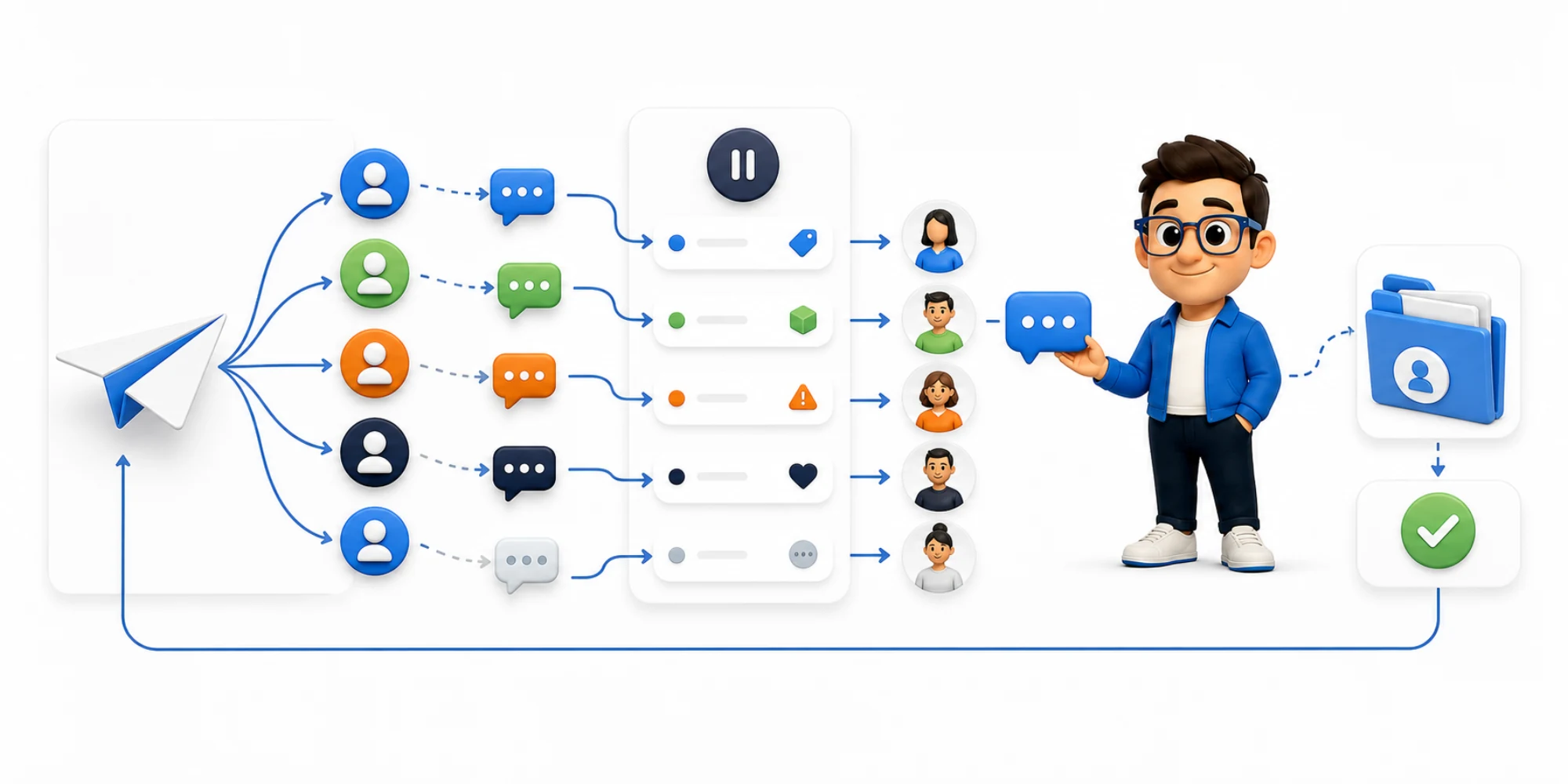
- Why would a customer reply to this message
- Which team owns the first response
- What should happen after common replies
- When will a person take over
Suppose a pottery studio sends an invitation for a weekend class. A reply could mean a booking request, a question about experience level, a request for another date, an opt-out or something unrelated.
The campaign brief should name the likely intents and the first action for each one. It does not need a complicated decision tree. A short table owned by marketing and operations is enough.
- Ready to book — Confirm required details: Sales or bookings
- Product or service question — Answer with campaign context: Trained service team
- Existing customer problem — Move to support without a new sales pitch: Support
- Stop request — Suppress future eligible sends: Campaign operations
- Unclear reply — Ask one clarifying question: Triage owner
Keep the campaign source attached
The first responder should see the exact message that prompted the reply, the campaign name, the customer record and any previous conversation. Without that context, a simple “yes” or “what about Friday” is almost meaningless.
Preserve the source when the reply enters the working queue. If the conversation moves from marketing to sales or support, keep it visible during the handoff.
This also makes reporting more honest. Connect a reply to a later booking, resolved question or opt-out without pretending every response was a conversion.
Route intent before measuring speed
Fast routing is useful only when the destination is right. Start with a small number of durable reply classes rather than dozens of keywords. Buying intent, service need, stop request and unclear reply cover many campaigns.
Automation can classify an obvious response, add the campaign source and assign an owner. It should not invent missing intent. A customer who writes “I need help” needs a clarifying question, not an automatic sales sequence.
The current WhatsApp Business Messaging Policy requires businesses to respect opt-out requests. It also says that on the Business Platform, an approved message template is required to initiate a conversation, while free-form replies are allowed within 24 hours of the user's last message. Your queue should therefore give stop requests immediate handling and show the timing context to the responder.
Stop automation from talking over people
Once a customer replies, competing outbound steps can make the business look careless. A reminder may fire while an agent is answering. A sales follow-up may continue after the customer has asked to stop. Two teams may respond because neither can see the other owner's work.
Define explicit stop conditions before launch. Pause or end the related sequence when the customer replies, when a teammate sends a manual response, when an opt-out is recorded or when the conversation moves into a service case. Resume only from a deliberate state.
That is an operating rule, not merely a software setting. Someone must test it with a real campaign path before the full audience receives the message.
Plan capacity from a small send
Do not borrow a reply-rate benchmark and use it as a staffing plan. Run a representative small batch, measure your own replies by hour and inspect how much work each type creates.
A hypothetical first batch of 100 messages might produce 12 replies. Five people want to book, three have questions, two ask for another date, one opts out and one reply is unclear. The service question may take longer than the booking, while the opt-out should be completed immediately.
Use the batch to decide how many owners must be available, which questions need approved answers and when to slow or pause the remaining send. WhatsApp's marketing message guidance recommends coordinated governance, end-to-end experiences and regular review against defined measures. Reply capacity belongs in that campaign plan.
Measure the work after the reply
Replied rate tells you whether people responded. It does not tell you whether the queue worked. Add a small operational set:
- time from customer reply to visible ownership
- time to first useful response
- share of replies still unassigned after the agreed window
- share routed to the wrong team
- stop requests completed before another send
- conversations that reached a verified next action
Review results by reply intent and campaign, not only by agent. A slow response may come from missing campaign context, an unclear offer or a queue opened when nobody was scheduled. Fix the system before blaming the person who inherited it.
With DripTell campaigns, replies can return to the shared inbox with their campaign source and customer record attached. Automation rules can classify, assign and pause follow-up, while the team inbox keeps ownership visible. The useful setup is still the one your operators have agreed to test and run.
The campaign send is the beginning of a conversation. Plan the reply queue with the same care you give the audience and message.
Frequently Asked Questions
Who should own replies to a WhatsApp campaign
Give one team responsibility for first triage, then route by intent. Sales can own booking or buying questions, support can own existing customer problems, and campaign operations should control suppression and opt-outs.
Should every campaign reply go to a human
No. Clear replies can be classified or answered with approved information. A person should take over when intent is unclear, judgment is needed, the customer asks for help or the automation cannot complete the next action safely.
What happens when someone opts out after a campaign
Record the request immediately, suppress future eligible sends and confirm the operating rule worked before sending another campaign. Keep the evidence needed to show when the request was received and applied.
How do you estimate reply capacity before a large send
Use a representative test batch and measure your own reply volume, timing and handling work. Staff for the mix of intents, not only the number of replies, and slow the send if the queue exceeds its agreed limit.
Want help applying this guide?Ask the DripTell team
From reading to action
Want help applying this to your business?
Share your details. We will read the article you are on and start with a useful answer for your team.
DripTell Editorial
Practical guidance reviewed by the DripTell product and customer workflow team.
See how DripTell checks product claims, uses primary sources and handles corrections.
Editorial and source policy