





Balanced assignment is not the same as sending the next conversation to the person with the fewest open tabs. A useful rule first asks who is allowed and able to handle the issue. It then protects capacity, orders the customer queue, preserves continuity, and confirms that someone accepted the work. If any gate fails, the conversation should remain visible in an owned queue instead of disappearing inside automation.
This matters because equal counts can hide very different loads. One agent may have four simple address changes. Another may have four payment disputes, two promised callbacks, and a customer waiting for a specialist. A round robin can look fair while making both the customer experience and the team less reliable.
The aim is not to distribute messages evenly. It is to distribute work so that every customer has a capable owner and no owner receives more active responsibility than they can safely finish.
| Area | What to verify |
|---|---|
| Start with eligibility | Before comparing workloads, define the pool of people who may receive the conversation. |
| Protect capacity before choosing an owner | Open conversation count is a useful starting point, but it is not workload. Decide what counts as active responsibility. A conversation waiting on the customer may consume little attention. |
| Prioritize the customer queue | Capacity tells you who can take work. It does not decide which customer should go next. |
| Assign with continuity and acceptance | Once the queue has chosen the next conversation, compare the eligible people with spare capacity. |
Start with eligibility
Before comparing workloads, define the pool of people who may receive the conversation. Eligibility should be based on facts that matter to the customer need, such as team membership, channel access, language, product knowledge, market, and permission to take the required action.
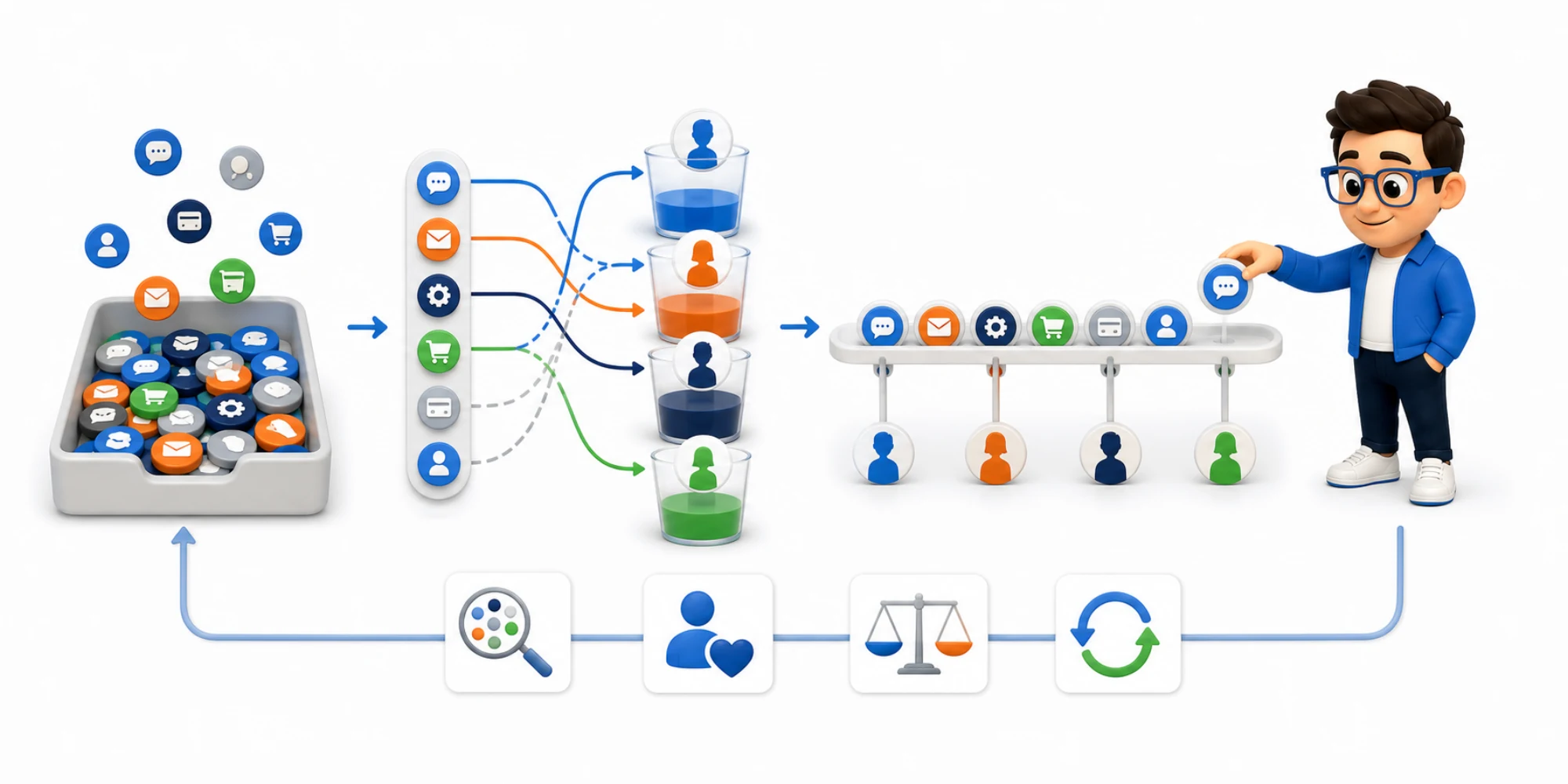
Keep the list short. If a billing question can be handled by the whole support team, do not invent a specialist label. If a refund needs manager authority, routing it to an agent who cannot approve one only creates a transfer.
Availability is a separate check. A person can be eligible but off shift, on leave, in training, or already handling a live call. Current routing systems often separate membership, status, skills, and capacity for this reason. Zendesk describes these as distinct routing inputs, not one magic score.
The fallback also needs an owner. When nobody is eligible and available, send the conversation to a visible exception queue with a named duty manager. Never drop it into an unmonitored bucket called other.
Protect capacity before choosing an owner
Open conversation count is a useful starting point, but it is not workload. Decide what counts as active responsibility. A conversation waiting on the customer may consume little attention. A promised callback due in ten minutes consumes real capacity even when no message is open on screen. Reopened work can also return to someone who is already full.
Use a small capacity model that your team can explain. For example, count live chats, time-bound promises, complex investigations, and ordinary asynchronous cases separately. Set limits by work type where the difference is material. Do not pretend that a phone call and an email have the same concurrency.
Limits should stop new automatic assignments, not hide demand. When everyone is full, the queue must remain visible with its age, priority, and reason for waiting. Intercom's current assignment guidance makes this operationally useful by exposing why a conversation is unassigned, such as no eligible teammate or everyone being at capacity.
Allow manual exceptions, but record who made them and why. A manager may knowingly place urgent work above a limit.
Prioritize the customer queue
Capacity tells you who can take work. It does not decide which customer should go next.
Create one ordering policy before traffic gets busy. A sensible sequence might put immediate safety or financial harm first, then promised deadlines, then conversations approaching a service commitment, then the longest customer wait.
Write tie breakers down. If two conversations have the same priority, use the oldest unanswered customer message. If they also have the same time, use a stable creation order.
Keep priority data trustworthy. An urgent label should come from a defined condition or a reviewed human decision. If every sales lead is urgent, the label no longer helps the routing system choose.
Assign with continuity and acceptance
Once the queue has chosen the next conversation, compare the eligible people with spare capacity. The lowest active load is a reasonable default, but continuity should usually win when the previous owner is still available and the customer need has not changed. Reassigning for a mathematically neater count can make the customer repeat context and can split responsibility for a promise.
New work needs an acceptance state. An assignment record says the system offered or placed the conversation. It does not prove that the agent saw it. Give the owner a short, realistic period to accept. If that expires, return the conversation to the queue, preserve the failed offer in the audit trail, and try the next eligible person.
Define what happens when work reopens. A reply after closure may belong with the previous owner, but only if that person is available, still has the right access, and has capacity. Otherwise route it again while keeping the earlier history attached. Front's load balancing documentation notes that reopened and manually assigned conversations can exceed automatic limits, which is exactly the edge case a local policy must handle.
Test the rule with real cases
Do not launch routing from a clean diagram. Take twenty recent conversations and replay them through the proposed gates. Include a language mismatch, an absent specialist, a reopened issue, a full team, an urgent deadline, a customer waiting on a promise, and two agents with equal counts but unequal complexity.
For each case, record six answers:
- Who was eligible and why
- Who was available
- What capacity each person had
- Why this customer was next
- Who accepted ownership
- What happened if the first choice failed
Then run the rule in shadow mode for a few days. Let it recommend assignments without moving work. Compare its choice with the duty manager's choice and investigate disagreements. The useful question is not whether the rule matched the human every time. It is whether both decisions used evidence that the team accepts.
After launch, measure unassigned age, time to acceptance, reassignment rate, capacity overrides, reopen distribution, and missed promises. Do not judge balance by equal case counts alone.
In DripTell's shared inbox, ownership, status, history, and private notes stay beside the conversation, while automation rules can route work by the facts your team actually uses. Start with the policy, though. Software can apply a clear decision consistently; it cannot rescue a rule that confuses equal counts with fair work.
Frequently Asked Questions
Is round robin enough for customer support
Round robin is suitable when agents have similar skills, availability, and case complexity. It becomes unreliable when permissions, channels, promises, or workloads differ. Use it only after eligibility and capacity checks.
How should reopened conversations be assigned
Prefer the previous owner when continuity helps and that person is still eligible, available, and below the relevant limit. Otherwise route the work again with the full history and previous promise attached.
What should managers measure after changing routing
Track how long work stays unassigned, how quickly owners accept it, how often assignments are overridden, where reopenings land, and whether customer promises are missed. Equal case totals are not enough.
Want help applying this guide?Ask the DripTell team
From reading to action
Want help applying this to your business?
Share your details. We will read the article you are on and start with a useful answer for your team.
DripTell Editorial
Practical guidance reviewed by the DripTell product and customer workflow team.
See how DripTell checks product claims, uses primary sources and handles corrections.
Editorial and source policy