

A missed delivery creates a choice, but not every choice is available for every parcel. A customer may prefer another attempt, collection, a safe place, or return to sender. Customer service should record that preference without turning it into a promise before the carrier confirms what the parcel can actually do next.
Start with the verified delivery event
First establish what happened. An “attempted delivery” scan, a door notice, and a parcel available for collection describe different states. Check the latest carrier record and any restriction shown for the shipment.
If the event is still vague, use the delivery exception guide first. That guide covers the earlier task: verifying an exception without guessing its cause. This article starts after a missed attempt is real and the team must choose the next step.
The UAE's official mail services page identifies postal, regular, express delivery and logistics services. Its consumer protection page says customers have a right to correct service information and suppliers must protect privacy. These rules support checking the specific service and communicating verified facts; they do not decide a parcel's next step.
Keep four states separate
The safest workflow keeps the carrier event, customer preference, carrier acceptance, and final instruction as separate records.
- 1EventVerify the missed-delivery state and source.
- 2PreferenceRecord what the customer wants without promising it.
- 3AcceptanceConfirm the option against the current parcel record.
- 4InstructionSend the verified place, window, action and fallback.
| Record | What it proves | Safe customer wording | Owner |
|---|---|---|---|
| Missed-delivery event | The carrier could not complete an attempt | “The carrier recorded a missed delivery.” | Support verifies the source |
| Customer preference | What the customer wants next | “You prefer collection on Tuesday.” | Conversation owner records it |
| Carrier acceptance | The carrier accepted an available option | “The carrier has confirmed collection from this location.” | Logistics or carrier liaison |
| Final instruction | What the customer should now do | Give the verified place, window, identification need, or next check | Named case owner |
Do not overwrite the original event when a customer asks for something else. A request to change an address is a different operation; the delivery address change guide explains why a requested reroute is not an accepted reroute.
Ask for a preference without promising it
A first response gives only supported choices. If the options are unknown, say so and ask one useful question.
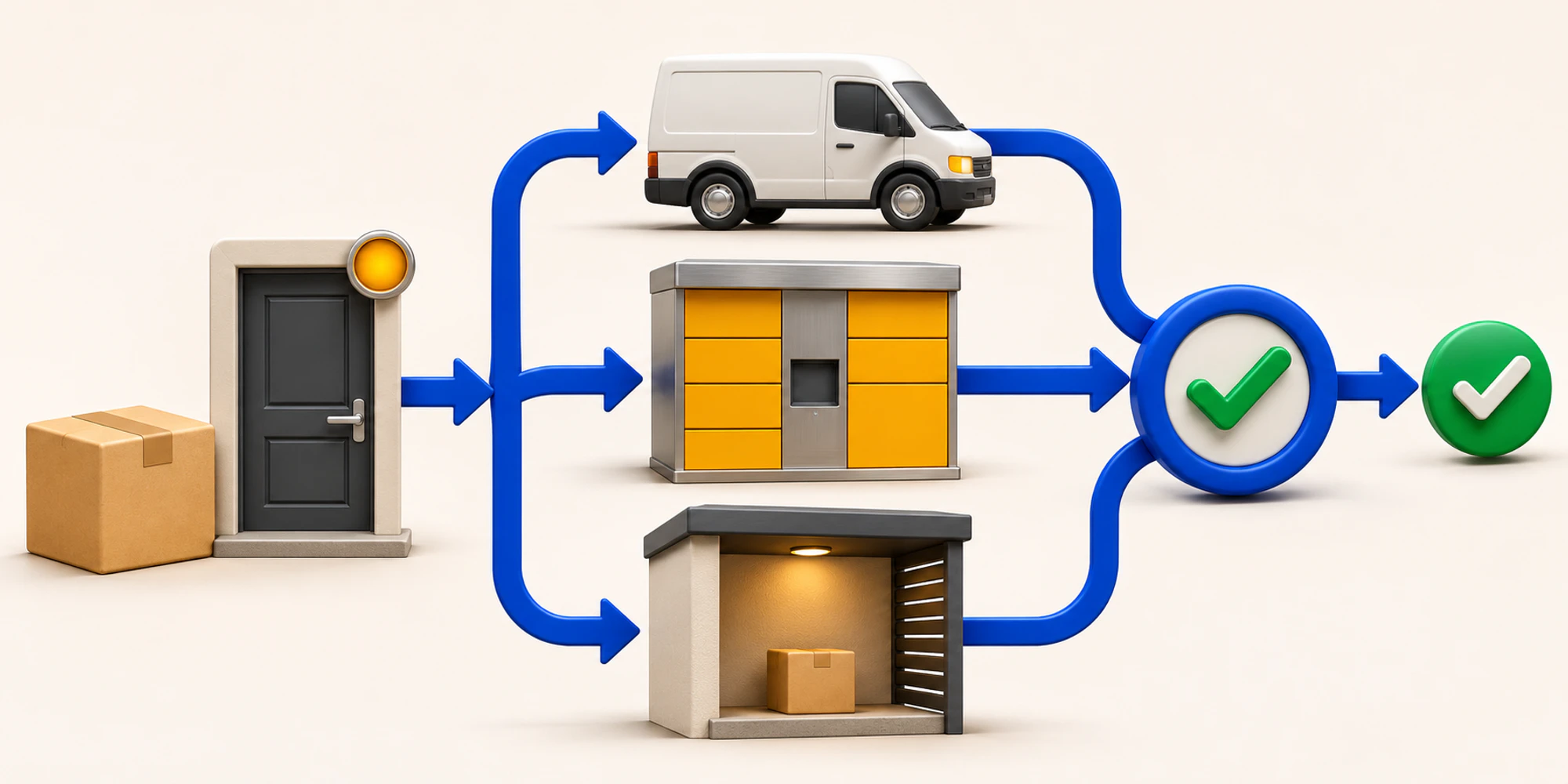
For example: “The carrier recorded an unsuccessful attempt. We are checking whether this parcel can be redelivered or collected. If both are available, which would you prefer?” This acknowledges the event, preserves uncertainty, and lets the team prepare without claiming that either option is confirmed.
Avoid “We will deliver tomorrow” when the customer only requested tomorrow, or “It is at the depot” when the scan only says an attempt failed.
Check the conditions behind each option
Before confirming redelivery, verify the date or window, address, signature rule, and whether another attempt must be booked. Before collection, verify the location, availability, holding deadline, and identification or authorisation requirement. Before a safe place, verify that the carrier and shipment permit it through an authorised process.
For another collector, explain the carrier's authorisation process.
Give the case one owner and one checkpoint
One person or queue should own the customer update until the next step is confirmed. A shared inbox can keep the conversation, private source note, owner, and promised update together. It does not confirm the carrier action by itself.
If a shift changes, use a customer service handover that names the parcel state, requested option, outstanding verification, and next update time. The receiving teammate should accept the task; a copied note is not a completed handover.
If the carrier misses the checkpoint, update the customer with what remains unknown and set a realistic new check. Silence invites conflicting promises.
Close the loop with the confirmed instruction
Once the carrier accepts an option, send one concise instruction: what changed, what is confirmed, what the customer must do, and what happens if the plan fails. Stop any obsolete reminders or automation that still offers the old option.
Keep other failure paths separate. If tracking says delivered but the parcel is missing, use the delivered-but-missing guide. The wider logistics and delivery overview can help teams connect messaging ownership to their carrier or warehouse process without pretending the messaging tool controls the shipment.
Review time to verification, corrected promises, repeat contacts, and whether the instruction matched the carrier record.
Frequently Asked Questions
Should support offer redelivery immediately
Only when the current carrier record shows that redelivery is available. Otherwise record the customer's preference and confirm the option before promising a date.
Can every missed parcel be collected
No. Availability, location, timing, identification, and holding rules vary by carrier, service, and parcel state. Check the specific shipment.
Is a safe place request a confirmed delivery instruction
Not automatically. Verify that the carrier and shipment allow it and that the request was accepted through the carrier's authorised process.
What should the customer receive after confirmation
Send the verified option, location or window, any required action, the next owner, and a clear fallback if the plan cannot be completed.
Want help applying this guide?Ask the DripTell team
From reading to action
Want help applying this to your business?
Share your details. We will read the article you are on and start with a useful answer for your team.
DripTell Editorial
Practical guidance reviewed by the DripTell product and customer workflow team.
See how DripTell checks product claims, uses primary sources and handles corrections.
Editorial and source policy