





A customer is ready to pay. The representative sends the call to an external payment endpoint. Ten seconds later, the customer is silent, the representative is on hold, and nobody watching the test can say whether recording actually stopped.
Do not release that journey after one successful payment. Test it with synthetic data, observe every privacy state, force the external endpoint to fail, and prove that the customer returns to a named owner. A successful transaction is only one part of a safe release.
Start with the customer promise
Write one plain promise before touching the configuration: the customer can complete a payment without speaking card details to a representative or leaving sensitive data in the contact center recording or transcript.
- Synthetic paymentUse provider-approved test accounts and payment data, never a real card.
- Approved destinationConfirm the external endpoint and bridged transfer configuration.
- Privacy transitionProve recording and transcription behave as the approved design requires.
- Failure returnRecover timeout, refusal and unavailable-endpoint paths without losing the customer.
- Accepted ownershipName who accepts privacy, payment, recovery and release evidence.
Then define what the contact center still needs. The representative may need to know that the payment step completed, failed, or was abandoned. They do not need the card number, security code, or keypad sequence. Your external provider should return the smallest useful result, linked to a test transaction reference that contains no secret.
Use test accounts and payment data supplied for that purpose by the payment provider. Never test with an employee's real card. Agree the amount, currency, expected outcome, cancellation path, timeout, and person who will recover the call. This keeps the exercise useful for customer support operations instead of turning it into an improvised technical demo.
Configure privacy deliberately
Microsoft's voice call experience configuration allows an external contact to follow the workstream settings, stop recording while keeping transcription, or stop both recording and transcription. It also lets an administrator keep the customer or the representative on hold during secure consult. Choose these settings from the data you must not capture, not from the easiest default.
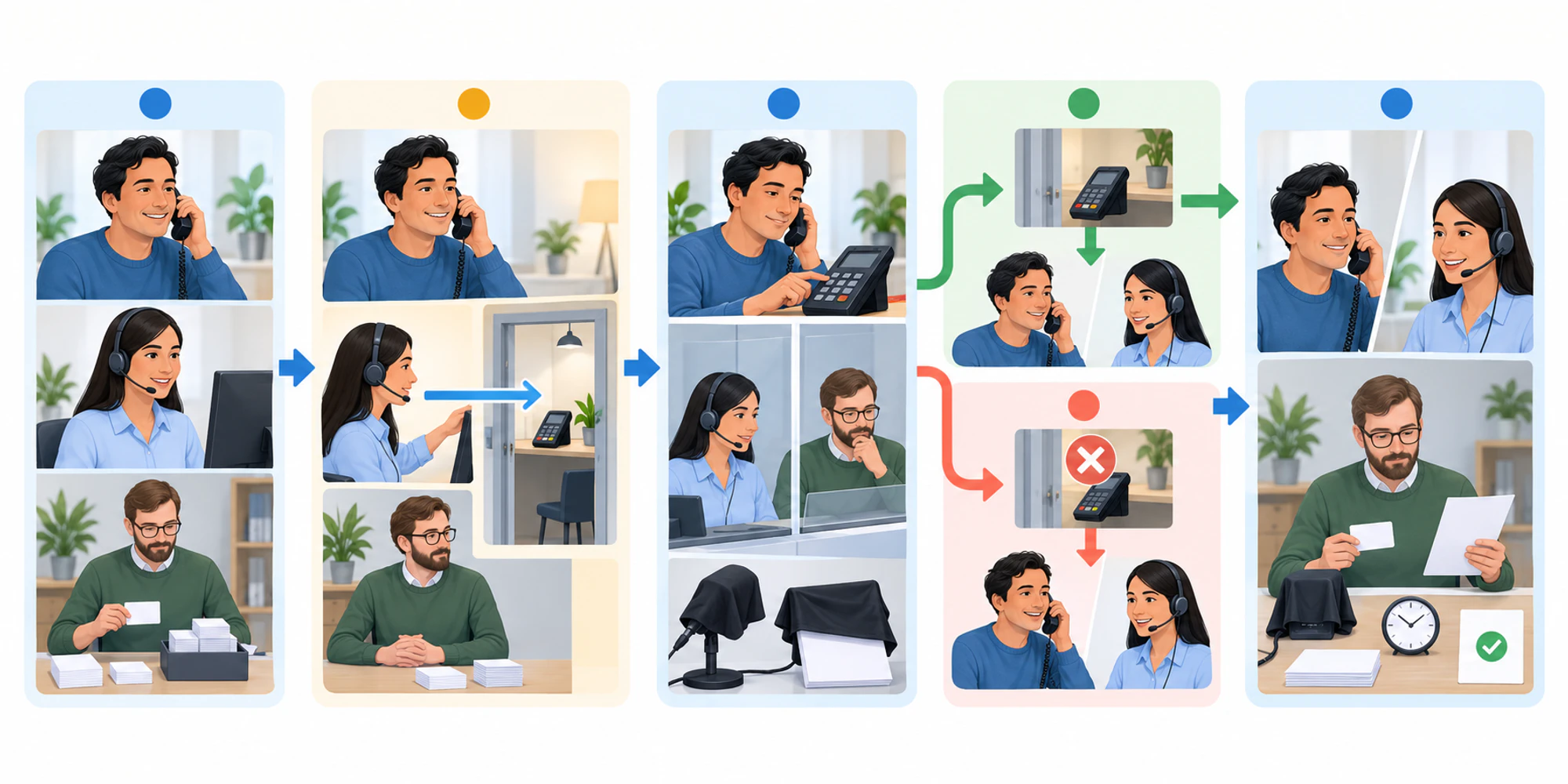
The same page warns that if secure settings are not configured, recording and transcription continue according to the workstream. It also says secure settings apply to bridged transfers initiated by representatives, AI agents, or overflow actions. Test every initiation path you intend to use. A manual representative test does not prove an automated path behaves the same way.
The Context Keeper appears in the hero only as a small privacy cue and for brand recognition. The article's inline decision flow is human-only so the operating sequence stays clear.
Run the happy path with synthetic data
Start recording your evidence before the call. Note the test case, workstream, external contact, configured privacy state, expected hold behavior, participant, start time, and test owner. Keep the actual keypad input out of the evidence pack.
Call through the same inbound number a customer will use. Let the representative explain what will happen, start secure consult or transfer, and observe the call from both sides. Confirm that the intended people are on hold, the customer can send keypad input to the external endpoint, and the representative cannot hear the sensitive step.
The current Microsoft runtime guidance says secure behavior depends on inbound external-number permission and bridged transfer. It also describes recording and transcription resuming when the external contact leaves, with participants removed from hold according to the configured rules. Verify those transitions in your tenant rather than assuming the screen setting proves them.
Test the failures before release
Most damage happens outside the clean path. Disconnect the external endpoint before it answers. Let it answer but not return a result. Have the customer cancel. End the secure leg first, then the original call. Refresh the representative session. Try a wrong destination that is not configured as a secure contact. Repeat from any AI or overflow path that can start the transfer.
Use a failure matrix so the team knows when to stop the release.
| Test condition | What must remain true | Evidence to keep | Release owner |
|---|---|---|---|
| External endpoint does not answer | Customer stays connected or returns to an owned recovery path | Call events and final owner | Voice operations |
| Customer cancels | No retry starts without consent | Provider result and case note | Service owner |
| Secure leg ends | Recording and transcription resume only at the intended boundary | Timeline without sensitive content | Privacy owner |
| Representative session fails | Customer is not stranded and ownership is visible | Routing and participant events | Platform owner |
| Wrong external number is chosen | Secure handling does not silently apply to an unapproved destination | Configuration result and blocked action | Security owner |
One failed case is enough to pause release. Do not average it away because nine other calls worked.
Keep evidence without keeping secrets
Your evidence pack should prove configuration, participant state, hold state, privacy transitions, endpoint result, return path, and accepted ownership. It should not contain real payment details, keypad digits, raw sensitive audio, or copied credentials.
Record the non-sensitive next action in a shared inbox and the confirmed business outcome in the customer record. Use automation controls only after the manual failure cases pass. If you also operate AI calls, apply the same rule there: automation may start a secure path, but a person still owns failure recovery.
Stopping recording is a control, not proof that the whole payment journey meets every legal, contractual, or card-industry requirement. Ask the payment provider, privacy owner, and compliance owner to accept their parts of the design. DripTell can help teams keep call outcomes, ownership, and follow-up visible; a focused demo is useful when you want to review that operating layer without copying sensitive payment data into it.
Frequently Asked Questions
Does secure transfer make the payment process compliant
No single feature proves compliance. It can reduce contact-center capture of sensitive data, but your provider, configuration, retention, access, evidence, and operating process still need review.
Should recording and transcription both stop
That depends on what the external step may contain and what your policy permits. For card entry, many teams choose the strongest available privacy setting, then test the actual runtime behavior.
What should the representative see after payment
Only the result needed to continue service, such as completed, failed, or cancelled, plus a non-sensitive reference. They should not receive the customer's card details or keypad sequence.
When is the flow ready to release
When the happy path and every required failure case pass with synthetic data, privacy transitions are verified, the customer always has an owned recovery path, and the responsible security, privacy, service, and platform owners accept the evidence.
Want help applying this guide?Ask the DripTell team
From reading to action
Want help applying this to your business?
Share your details. We will read the article you are on and start with a useful answer for your team.
DripTell Editorial
Practical guidance reviewed by the DripTell product and customer workflow team.
See how DripTell checks product claims, uses primary sources and handles corrections.
Editorial and source policy